 |
|

|
Type :
|
Military transport aircraft
|
|
Country :
|
Russia / Ukraine
|
|
Manufacturer :
|
Antonow ASTC (Aeronatical/Scientific Technical Complex)
|
|
Crew (Besatzung) :
|
2 - 5
|
|
Passengers (Passagiere) :
|
110 paratroops or up to 300 soldiers if a second deck
is installed in the cabin.
|
|
Power plant (Antrieb) :
|
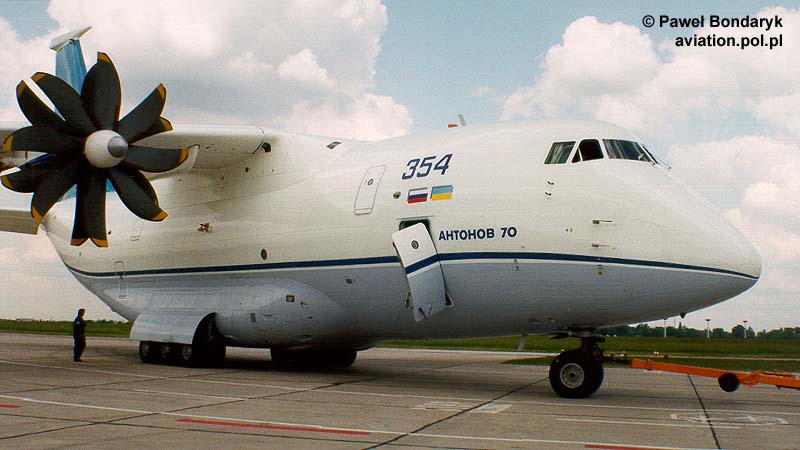
4 x Progress D-27 driving Aerosila SW-27 counter-rotating propfans (eight and six blades with a diameter of 4,5 m each) |
|
Power (Leistung): 4 x 10300 kW (14000 shp) at take-off;
4 x 5030 kW (6750 shp) during cruise at a height of 11000 m
|
|
|
Dimensions (Abmessungen) :
|
Length: 40,73 m --- Height: 16,38 m --- Span: 44,06 m |
|
Cargo compartment Dimension :
|
height: 4,1 m --- Width at floor: 4 m --- length:
19,1 m (22,4 m with ramp) Floor area: 89 sq m
|
|
Cargo compartment volume :
|
425 cu m
|
|
Empty weight :
|
73 tons
|
|
Max. payload :
|
47 tons
|
|
Max. fuel :
|
38 tons
|
|
Max. take-off weigth
|
135 tons
|
|
Cruise speed :
|
750 - 800 km/h
|
|
Cruising altitudes :
|
9000 - 12000 m
|
|
Required field length :
|
- 1800 m with max payload 600- 900 m with reduced payload from unpaved runways |
|
Range :
|
- 1350 km with 47 tons of cargo - 3800 km with 35 tons of cargo - 5000 km with 30 tons of cargo (2600 km when taking off from 900 m runway) - 7400 km with 20 tons of cargo (3000 km when taking off from 600 m runway) |
|
Cost :
|
around 50 million US-Dollars
|
|
Competition :
|
Airbus Military Aircraft FLA |
|
More about engine :
|
Four ZMKB Ivchenko Progress D-27 propfans Power : 9863 KW or 13,239 shp each Length : 4.205 m Fan diameter : 0.97 m Propeller diameter : 4.5 m Specific fuel consumption : 0.4 kg/kg.thrust/hr or 0.287 lb/ehp/hr (40% better economy than equivalent turboprops). Total compressor stages : 9 Total turbine stages : 5 The 14000hp D-27 profan engine is designed to power high-efficiency passenger and transport airplanes with improved takeoff and landing characteristics. Profan diameter - 4.5m. The engine was created by Ivchenko Progress Design Bureau and is manufactured by Motor-Sich JSC (Zaporozhye, Ukraine). |
|
Propellers :
|
Stupino SV-27 contrarotating, each engine with eight composite blades in front and six at rear. |
|
Flight control system :
|
Araelectrik Triplex digital fly-by-wire and six analog channels. Four independent hydraulic systems. |
|
Avionics :
|
Architecture : Integrated Arinc-700 specs Aviapribor avionics Six Electroavtomatika color digital CRT main MFD plus four secondary CRT. Laser INS HUD Ski-77 ILS Cat IIIa Aviapribor FMS |
|
Othervisions :
|
The civilian An-70T with four engines will be able to carry 35 tons over 3,800 km or 20 tons over 7,400 km, whereas the respective figures for the An-70T-100 with two engines will be 30 tons over 1,000 km and 10 tons over 7,700 km respectively. From a 2500 m runway it yields 30 tons over 1,000 km. or 20 tons over 4,300 km. |
Link: A Webpage special focus on An-70
| Development of the An-70 as a replacement for the An-12
transports of the Soviet forces began in the 80s. A model was shown for
the first time in April 1992, when some technical details were also released.
First prototype rolled out from the factory on 20 January 1994, but a
short first flight did not take place before December 16 that year. This
aircraft was lost on the fourth flight due to a collission with the An-72
chaseplane, killing all seven crewmembers on board. A second prototype
was then constructed, which took langer than hoped due to the precarious
financial environment in which Antonow has to work due to the break-up
to the USSR: Many of the suppliers are in Russia, which is now a foreign
country. Second prototype rolled out December 24, 1996 in the presence of Ukrainian president Leonid Kutchma. First flight on 24. April 1997 with test pilots Alexander Galunenko and Anatoli Andronow from the Russian air force. Public debut at the Moscow air show in August 1997. In October 1997, German defence minister Volker R¨ the intention to study whether the An-70 could be the basis for a new NATO transport aircraft. Evaluation will probably be in competition with the new-designed FLA proposed by Airbus Military Company. |