| The
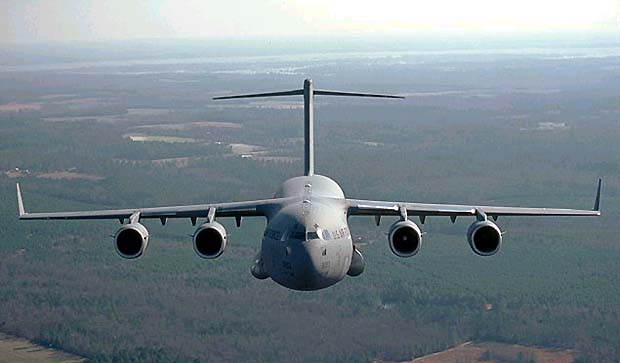
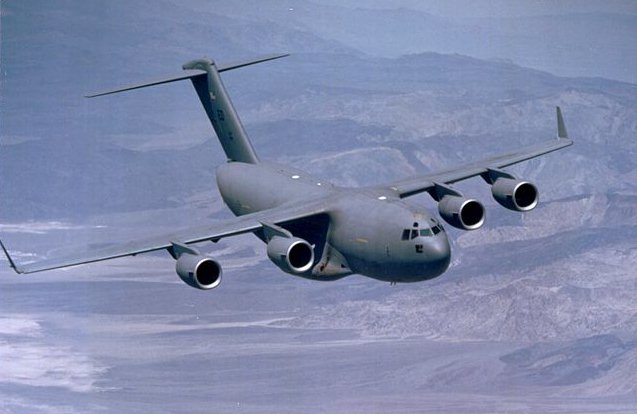
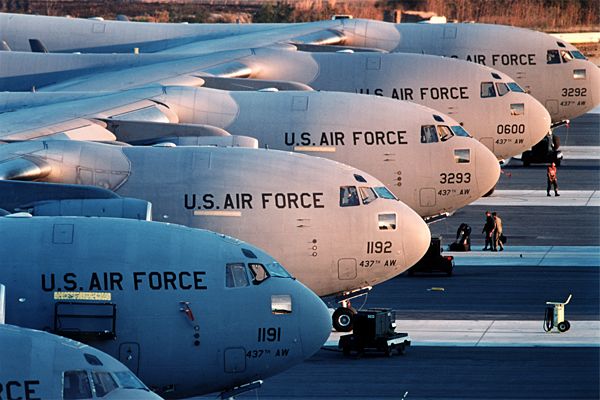
McDonnell Douglas C-17 Globemaster III military airlift aircraft is capable
of carrying payloads up to 169,000 pounds, with international range and
the ability to land on small airfields. A fully integrated electronic
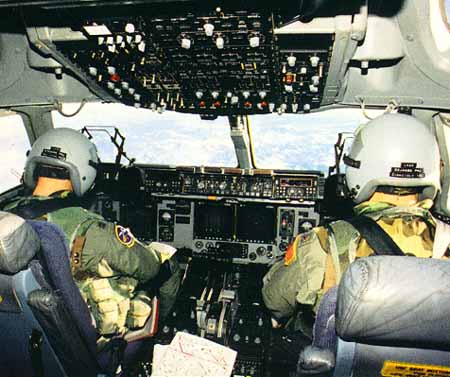
cockpit and advanced cargo systems allow a crew of three, the pilot, copilot
and loadmaster, to operate all systems on any type of mission.
CARGO COMPARTMENT
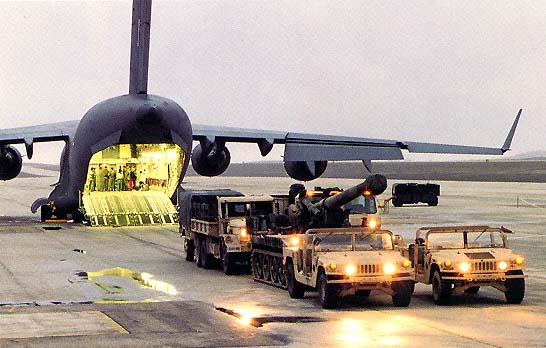
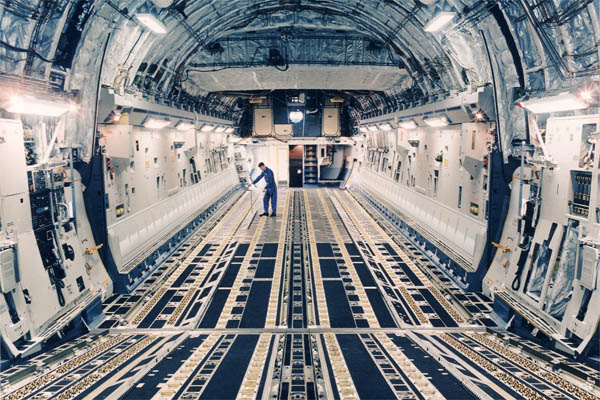
The design of the cargo
compartment allows the C-17 to carry a wide range of vehicles, palleted
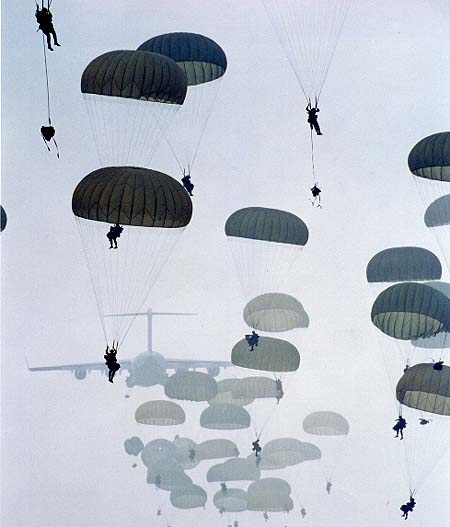
cargo, paratroops, airdrop loads and aeromedical evacuees. The cargo
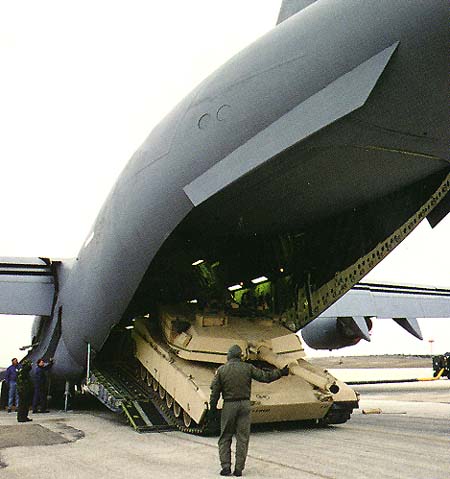
compartment has a sufficiently large cross section to transport large
wheeled and tracked vehicles efficiently, including trucks, tanks, helicopters
such as the AH-64 Apache, artillery and weapons such as the Patriot
Missile System. The C-17 is capable of carrying out an airdrop of outsize
firepower such as the Sheridan tank or the Bradley fighting vehicle
if the Bradley is refitted to be airdrop capable. Three Bradley armoured
vehicles comprise one deployment load on the C-17. The US Army M-1 main
battle tank can be carried with other vehicles.
Airlift capabilities include:
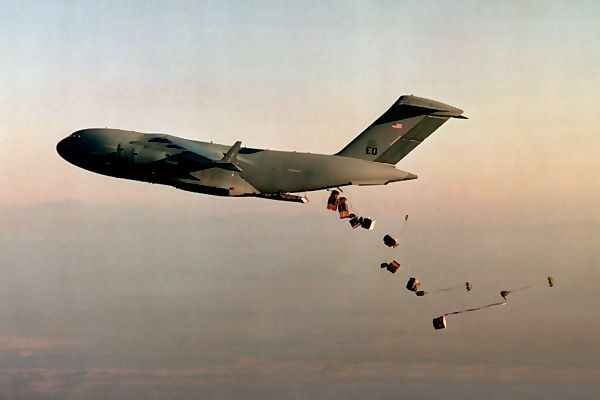
combat offload up to 18 pallets, 69,000 pounds; Container Delivery System,
CDS, airdrop up to 40 containers, 2,350 pounds each; up to 102 paratroops;
High altitude, low opening (HALO) jumpers. The aircraft is equipped
for LAPES low altitude parachute extraction system drops.
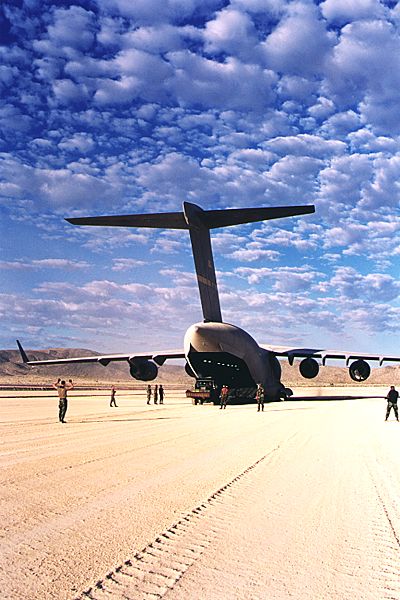
SHORT RUNWAY LANDINGS
A propulsive lift system
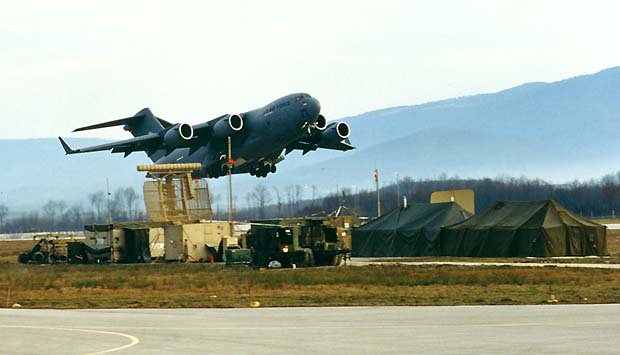
allows the C-17 to achieve safe landings on short runways. The C-17
is capable of landing a full payload in less than 3000 feet. The propulsive
lift system uses engine exhaust to generate lift. The engine exhaust
is directed onto large flaps which extend into the exhaust stream allowing
the aircraft to fly a steep approach at a relatively low landing speed.
SEVERE TACTICAL ENVIRONMENTS
The C-17 is customised
for routine operations in severe tactical environments, including frequent
low- altitude, high speed missions and repeated landings at small austere
airfields. This capability allows the C-17 to avoid large congested
airfields and deliver the cargo closer to the battle zone or operational
area.
TURBOFAN ENGINES
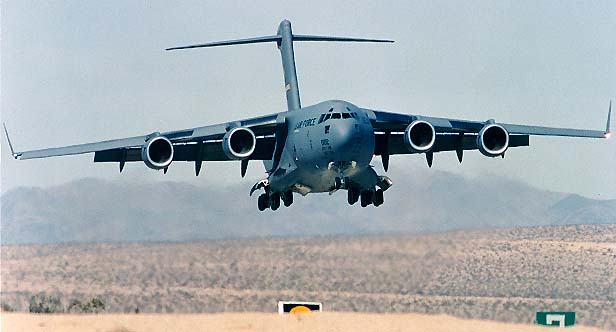
The four turbofan engines,
Pratt and Whitney PW2040, are integrated in the wings. Engine thrust
reversers which are operable in flight and speedbrakes enable the aircraft
to carry out rapid deceleration and descent manoeuvres.
The cruise speed is between
0.74 and 0.77 Mach. The range without in-flight refuelling and with
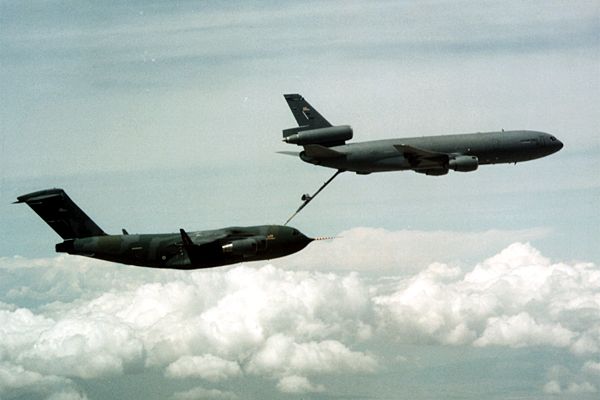
a payload of 160,000 pounds, is 2,400 nautical miles. Aerial refuelling
provides intercontinental non-stop range.
ON-GROUND MANOEUVRABILITY
The aircraft is capable
of turning in a small radius and can complete a 180 degree star turn
in 80 feet. The aircraft can also carry out routine backing. A fully
loaded aircraft is capable of backing up a 2% gradient slope using the
directed flow thrust reversers.
COUNTERMEASURES
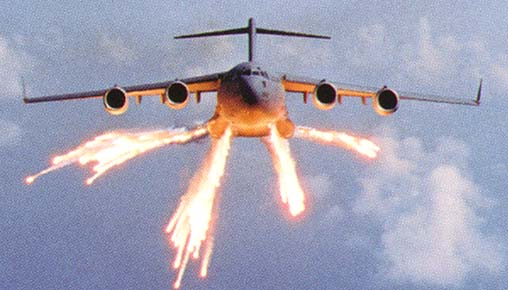
The C-17 has the space,
weight and power provision for Tracor AN/ALE-47 countermeasure flare
dispensers and the Lockheed Martin/Hercules AN/AAR-47 missile warning
system. The development of the defensive systems was completed in 1994
and installation on five C-17 aircraft was completed by 1996.
AN/AAR-47 is a passive
missile warning system which detects missiles by detecting the heat
emitted in the exhaust during the missile launch and boost phase. The
system is composed of a suite of thermal sensors with four photomultipliers,
a signal processing unit and a cockpit mounted control indicator. The
suite of surface mounted thermal sensors around the aircraft provide
360 degree coverage. Frequency selection and signal processing techniques
are used to minimise the false alarm rate. The system provides a warning
to the crew via the cockpit indicator unit of the presence and direction
of the missile threat. A signal is automatically sent to the ALE-47
countermeasures dispenser.
AN/ALE-47 is capable of
carrying a mix of expendable countermeasures including expendable jammers.
The system interfaces to the C-17 aircraft's sensors. The aircrew can
select the mode of operation of the dispenser for fully automatic, semi-automatic
or manual operation.
The cockpit control unit
can be used to input mission data together with the numbers and types
of expendable countermeasures systems loaded into the ALE-47. The cockpit
controller updates and displays the status of the dispenser and the
numbers and types of countermeasures remaining. The ALE-47 is capable
of dispensing the new generation active expendable decoys POET and GEN-X
in addition to the conventional chaff and flare decoys which are compatible
with the previous generation ALE-40 and ALE-39 dispensers.
In fully automatic mode
the dispenser receives the threat data from the aircraft's sensor system,
selects the appropriate response in the choice of expendable, the dispersal
sequence and pattern, and dispenses the selected expendable decoy. The
ALE-47 automatically downloads data to programme active expendable decoys
before the launch sequence.
In semi-automatic mode
the launcher analyses the threat data input, selects the best response
and provides a signal to the aircrew that the system is ready. In a
fully manual mode the crew are able to select one of six pre-programmed
responses in which the quantities, sequences and types of expendables
produce the required decoy pattern.
DAMAGE TOLERANCE, FIRE
PREVENTION AND SHIELDING
The design incorporates
extensive redundancy and separation of components and flight control
surfaces. The fuel system comprises four independent wing tanks, with
two boost pumps per tank. The fuel system is configured such that any
tank can feed any engine. Continuous nitrogen inerting of the fuel tank
and vent lines is achieved using an onboard inert gas generating system,
OBIGGS, which is pressurised by engine bleed air. The structure features
a multiple path structure for load carrying and selective routing of
electrical wiring away from lines carrying flammable liquids.
|